
The bathhouse in Spirited Away is the only place in a Studio Ghibli film that works like a real job, and that is the secret of the whole film. Chihiro does not save the spirit world with a sword or a spell. She gets hired, scrubs floors, takes the worst shifts and slowly earns the respect of the people she works beside.
Hayao Miyazaki released Spirited Away in Japan in July 2001, and it went on to win the Academy Award for Best Animated Feature in 2003. Most of its story takes place inside one enormous building by the sea, and every floor of it has its own rules, smells and characters. Here is why the bathhouse is worth a closer look, and why it may be the best setting Ghibli ever built.
A palace of baths for eight million gods

At nightfall, lanterns light up across the river and the guests of Yubaba's bathhouse arrive: spirits and gods of every shape, stepping off a ferry to rest and bathe.
Japanese folk belief speaks of eight million gods, one for every river, field and season, and the film imagines where they go when they are tired. Masked spirits in red robes, a giant radish spirit, a flock of small yellow bird spirits soaking in a tub together: each guest is drawn in a single shot and never explained, which makes the world feel far bigger than the story.
The building itself mixes a traditional Japanese bathhouse with the Western-style architecture of early twentieth-century Japan, all red lacquer, painted ceilings and electric light. It is grand and slightly shabby at once, like an old hotel that has seen better days, and Miyazaki fills every corridor with detail you only notice on a second watch.
Kamaji and the boiler room at the bottom

Chihiro's first stop is the boiler room, run by Kamaji, an old man with six long arms who heats the water and mixes the herbal bath salts for every tub above him.
Bunta Sugawara, a veteran of Japanese gangster films, voices Kamaji in Japanese with a gruff, tired growl. He shouts that he has enough hands already and does not need a child getting in his way. Then, a scene later, he quietly tells the staff that Chihiro is his granddaughter, so she will be taken upstairs to ask for work.
It is the first act of kindness Chihiro receives inside the bathhouse, and it comes from the grumpiest person in it. The film keeps doing this. Help never comes from the people who look friendly. It comes from workers who are busy, tired and rude, and who still choose to look out for a frightened girl.
The soot sprites who carry the coal

Kamaji's helpers are soot sprites, tiny balls of black fluff with wide eyes who carry lumps of coal into the furnace and are paid in star-shaped candy.
Fans of My Neighbor Totoro will recognise them, because the same little creatures fill the empty house in that 1988 film. Here they have jobs. When one of them drops under the weight of its coal, Chihiro picks up the lump and carries it herself, and suddenly every sprite in the room drops its coal and waits for her to do the rest.
It is one of the funniest moments in the film and also a quiet lesson about work. Kamaji scolds Chihiro for taking another worker's job, and he is right. The bathhouse runs because everyone does their own part, and the soot sprites are the smallest and most charming example of that rule.
Yubaba's office on the top floor

At the top of the bathhouse lives its owner, the witch Yubaba, voiced by Mari Natsuki: a huge head, heavy jewelled rings and a temper that fills the room.
Getting to her office is a test in itself, a long ride in a lift and a walk down a corridor of doors that open on their own. Yubaba runs her business like a ruthless manager. She hires Chihiro only because she once swore an oath to give work to anyone who asks for it, and she makes the girl sign a contract on the spot.
The contract is the turning point of the first act. Yubaba takes most of the characters of Chihiro's name and leaves her with a new one, Sen. In the bathhouse, a worker who forgets who she was can never leave, and the film makes that idea frightening without ever raising its voice.
Lin, the older sister Chihiro never had

Chihiro is put to work under Lin, a sharp-tongued young woman voiced by Yumi Tamai, who complains about her from the first minute and then never stops helping her.
Lin is everything Chihiro is not yet: quick, brave and unafraid of the bosses. She shows the new girl where to sleep, what to wear and how to keep her head down in front of the bosses. At night the two of them sit together in the workers' quarters, and Lin tells Chihiro that one day she will leave the bathhouse and go to the town across the water.
That small dream makes Lin one of the most human characters in the film. She is stuck in a job she does not love, in a place that does not care about her, and she still gives some of her strength to a stranger. We think she is the most underrated character Miyazaki ever wrote, and she rewards a second viewing more than anyone else in the film.
The worst customer of the night

Chihiro's first big job is the guest nobody wants: a spirit so filthy that the staff gag at the smell, and Yubaba sends the new girl, with Lin, to serve him.
This is the set piece where the bathhouse turns from a backdrop into a stage. Chihiro holds her breath, wades into sludge up to her knees and fills the giant tub with the best herbal water while the whole staff watches from the balconies. Down in the boiler room, Kamaji sends up the hottest herbal water he has.
We will not say what happens when the bath is finished, because it is one of the most satisfying surprises in the film. What matters is that Chihiro does the job everyone else refused, and she does it well. For the first time in the story, the bathhouse looks at her and sees a worker instead of a lost child.
Why the bathhouse still works

Spirited Away was written and directed by Hayao Miyazaki for Studio Ghibli and scored by Joe Hisaishi. In 2001 it became the most successful film ever released in Japan.
We think the bathhouse is the reason. It gives a fantasy film the shape of a first job: a scary boss, a mentor who pretends not to care, rules nobody explains and the slow pride of doing the work right. Every adult remembers that feeling, and every child watching gets a picture of how growing up actually happens.
Watch it again with your eyes on the background. The kitchen full of steaming dishes, the frogs in their work aprons, the long red bridge in the morning light: the bathhouse is so full of life that it feels like the place would keep running even if nobody were watching.
Where to watch
Streaming catalogues for Studio Ghibli differ between the USA, the UK, Canada and Australia, and they change from month to month, so check the services you use.
Shop the Studio Ghibli collection
Liked Studio Ghibli? This is where it leaves the screen: every Studio Ghibli design we carry, in one place.
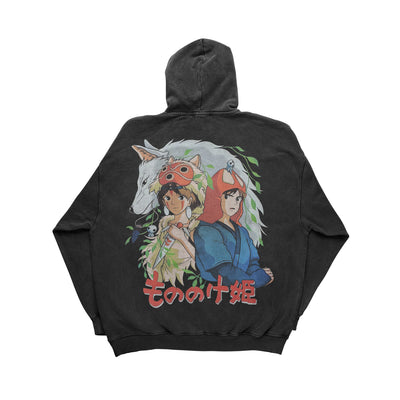
 Princess Mononoke San & Ashitaka Vintage Anime Hoodie Double Sided$24.99
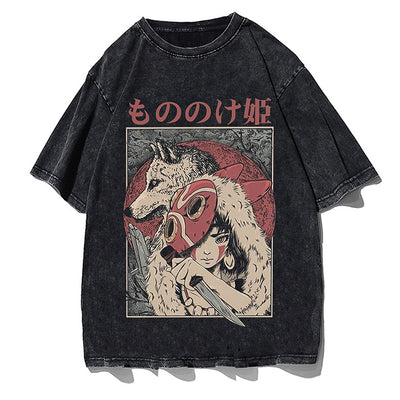
 Studio Ghibli Mononoke Hime Vintage Oversized Graphic T-Shirt$20.99
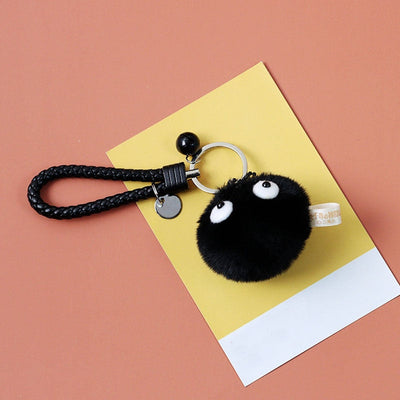
 Studio Ghibli Spirited Away Susuwatari Soot Sprite Plush Keychains$11.99
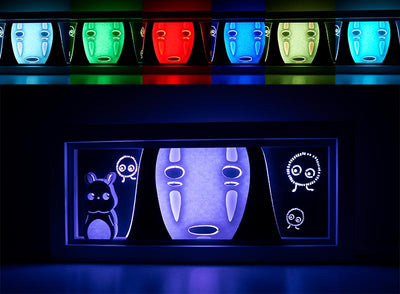
 Studio Ghibli Spirited Away Kaonashi No Face RGB Led Light Box$19.99
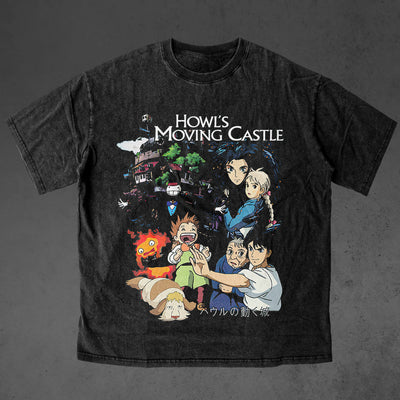
 Studio Ghibli Howl's Moving Castle Oversized Graphic T-Shirt$20.99
 Studio Ghibli Embroidered Jet Tag Keychain - Calcifer (Howl's Moving Castle)$9.99
Sources: Studio Ghibli, Spirited Away (official), Ghibli Museum, Mitaka (official).