
San is the only Studio Ghibli heroine who walks on screen with blood on her face. That first image, a girl in a wolf pelt spitting blood from a wound in a giant wolf's side, tells you this is not a film where the heroine waits to be rescued.
Hayao Miyazaki released Princess Mononoke in Japan in July 1997, and the title character is still the angriest, most uncompromising lead he ever drew. She is not there to be liked. She is there to defend a forest against the people who are cutting it down, and she has decided she is not one of them. Here is why she still hits almost thirty years later.
A human child given to the wolf god Moro

San was a baby when her parents threw her to the wolf god Moro as they fled the forest. Moro raised her as a daughter, beside her own two pups.
The film never treats this as a sad orphan story. San grew up running with wolves, eating with wolves and thinking like one, and she sees humans the way the wolves do: as a loud, greedy tribe that burns trees and digs up mountains. When Moro calls her daughter, she means it, and San answers to it without a second thought.
Akihiro Miwa voices Moro in Japanese and Gillian Anderson in the 1999 English dub, and the wolf is one of Miyazaki's great creations: huge, sardonic, old and tender with exactly one creature in the world. Every scene between Moro and San shows a mother who knows her child will never fully belong to either side.
The night San runs across the roofs of Irontown

San attacks Irontown alone at night. She runs along the rooftops in her mask, dodging bullets and leaping over the walls of the fortress town.
It is one of the great action sequences in Ghibli history, and it is built on how light she is. The townspeople fire guns, light torches and shout from every corner, and San moves through all of it like a thrown knife. Miyazaki keeps the camera close to her feet and her spear, so the whole raid feels like a wild animal loose in a crowded place.
What the scene makes clear is that she came to kill one person. She is not raiding for food or for glory. She wants Lady Eboshi, the woman who runs Irontown and cut down the forest to feed its furnaces, and she does not care what it costs her.
San and Lady Eboshi, two women who will not back down

San finally reaches Eboshi in the middle of the town, and the two of them fight blade to blade while the crowd closes in around them.
This is where the film shows its hand. Eboshi is not a cartoon villain. She bought the freedom of women sold to brothels, gave them work at the bellows, and cares for lepers that no one else will touch. Yuko Tanaka voices her in Japanese and Minnie Driver in English. She is cold toward the forest and warm toward her people, and she means both.
San is the mirror image: tender with wolves, merciless with humans. Putting them face to face, both furious and both partly right, is what lifts Princess Mononoke above a simple story about nature against industry. Neither woman is wrong about what she is protecting.
The mask, the pelt and the red marks on her face

San's look is one of the most recognised designs in anime: a white wolf pelt for a cloak, a clay mask painted red, tooth earrings and three red marks on her face.
Every piece of it says something. The mask turns her into a forest spirit when she fights, the pelt is her family's fur, and the red paint on her cheeks and forehead makes her look like she has already been in a battle. Miyazaki designs her so that the costume is a statement of whose side she is on, not decoration.
Under all of it is a teenage girl with a plain, serious face. The film keeps cutting between the mask and the face underneath, and that contrast is the character: a human who has made herself into something wilder because she wants nothing to do with the people she was born among.
A knife held over the boy who stopped the fight

Ashitaka, a young prince from the east, ends the fight in Irontown by knocking both women out and carrying San away. When she wakes, she holds a knife over him.
It is the turning point of her story. Ashitaka is wounded and cursed, and he looks at the furious girl with a blade at his throat and tells her that she is beautiful. San has no idea what to do with that. Nobody has ever said such a thing to her, and for the first time in the film she hesitates.
Yoji Matsuda voices Ashitaka in Japanese and Billy Crudup in English, and the scene works because he is not flirting. He is simply telling her the truth as he sees it, and that is a harder thing for San to fight than any rifle in Irontown.
Caring for a stranger in the forest

San takes Ashitaka deep into the forest to the lake of the Forest Spirit, and when he is too weak to eat, she chews dried meat and feeds it to him herself.
It is one of the most intimate scenes in any Ghibli film, and there is nothing romantic about how it is staged. San does it the way a wolf mother would feed a cub, without fuss or embarrassment. Ashitaka cries while he eats, and the film lets that moment sit in silence, with only the forest around them.
This is where San stops being only a warrior. She still says she hates humans, and she still means it, but her actions are already ahead of her words. Miyazaki trusts us to notice, and never says it out loud.
Why San still matters

Princess Mononoke was written and directed by Hayao Miyazaki for Studio Ghibli and scored by Joe Hisaishi. In 1997 it became the biggest film ever released in Japan, until Titanic passed it the following year.
Its English version arrived in 1999 with a script by the novelist Neil Gaiman, and Claire Danes voiced San. Yuriko Ishida plays her in Japanese with a low, rough voice that never once asks for sympathy. Between the two performances, San became the template for a whole generation of fierce animated heroines who fight for something bigger than themselves.
We think she endures because Miyazaki refused to soften her. She does not learn that humans are fine after all. She stays angry, stays loyal to the wolves and stays exactly who she is, and the film respects her for it. That is rare in any animated film, and it is why San still feels dangerous today.
Where to watch
Streaming catalogues for Studio Ghibli differ between the USA, the UK, Canada and Australia, and they change from month to month, so check the services you use.
Shop the Studio Ghibli collection
Liked Studio Ghibli? This is where it leaves the screen: every Studio Ghibli design we carry, in one place.
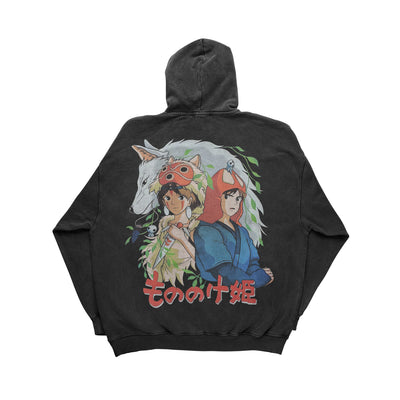
 Princess Mononoke San & Ashitaka Vintage Anime Hoodie Double Sided$24.99
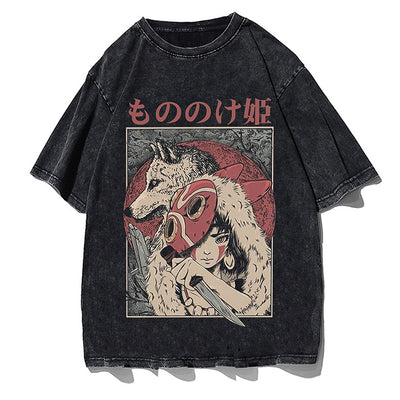
 Studio Ghibli Mononoke Hime Vintage Oversized Graphic T-Shirt$20.99
 Studio Ghibli Spirited Away Susuwatari Soot Sprite Plush Keychains$11.99
 Studio Ghibli Spirited Away Kaonashi No Face RGB Led Light Box$19.99
 Studio Ghibli Howl's Moving Castle Oversized Graphic T-Shirt$20.99
 Studio Ghibli Embroidered Jet Tag Keychain - Calcifer (Howl's Moving Castle)$9.99
Sources: Studio Ghibli, Princess Mononoke (official), Ghibli Museum, Mitaka (official).