
Castle in the Sky is the first film Studio Ghibli ever made, released in Japan in August 1986, barely a year after the studio opened its doors in 1985. It has sky pirates, a glowing stone, an army in pursuit and an island hidden inside a storm cloud, and it moves like a studio with everything to prove.
We think it is still the purest adventure film Hayao Miyazaki has made. Later Ghibli films are deeper and stranger, but none of them is this generous with pure momentum, and none of them makes a chase across a mining town feel this much like flying. Here is why it still works forty years on.
A girl who falls out of the sky

The film opens with sky pirates attacking a government airship. Sheeta, a quiet girl held on board, slips out of a window during the raid and falls into the dark, and the stone around her neck begins to glow.
She does not crash. She floats down, very slowly, into the arms of Pazu, a boy working the night shift at the local mine. The sequence lasts barely a minute, and it tells you everything about the film's tone: danger first, then wonder, then a kid who simply decides to help.
By the next morning, everyone wants that stone. Miyazaki gets the plot moving in the first ten minutes and never really lets it stop.
Pazu, the boy who wants to prove his father right

Pazu lives alone above the mine, keeps white pigeons on his roof and greets them with his trumpet at dawn. His late father once photographed a floating island called Laputa, and nobody believed him.
That photograph is the engine of the whole film. Pazu is building a small flying machine in his spare time because he wants to finish his father's journey, and when a girl with a floating stone lands in his arms, he takes it as a sign. Laputa, a name borrowed from Jonathan Swift's Gulliver's Travels, stops being a story and becomes a destination.
He is a classic Miyazaki boy: practical, brave, a little reckless, and kind without ever making a speech about it. The scene where he shares a fried egg on toast with Sheeta is one of the most quoted meals in anime.
The pirates you end up loving

Captain Dola and her grown sons are sky pirates, and they are after Sheeta's stone from the first scene. They are loud, greedy and very funny, and they are the best supporting cast in any early Ghibli film.
Dola runs her airship, the Tiger Moth, like a ship of fools that somehow always works. Her sons are huge men who fall over themselves to impress Sheeta the moment she joins the crew, and Dola herself is sharper and warmer than she first lets on.
This is one of Miyazaki's favourite tricks, and Castle in the Sky is where he first did it at full length: the villains of the first act become the family of the third. By the time the pirates and the children are flying side by side in tiny flapping gliders, you would follow Dola anywhere.
Muska, a villain in dark glasses

The real threat wears a suit. Muska is a government agent who works with the army and wants the stone for reasons he keeps to himself, and he is calm, polite and frightening in a way the pirates never are.
Where Dola wants treasure, Muska wants power, and the film draws that line clearly without ever lecturing. The army's General Mouro is a blustering soldier who thinks the mission is about gold. Muska knows it is about something much bigger, and he is happy to let the general find out too late.
Miyazaki returns again and again to the idea that the most dangerous people in a story are the ones who want to control technology rather than enjoy it. Muska is the first great version of that villain, two decades before the arms dealers and warlords of his later films.
A robot that is gentler than the people chasing it

Inside the army's fortress lies a fallen robot from Laputa, long thought to be dead. When Sheeta's stone flares, the machine wakes, and the film shows you, all at once, what the island's builders were capable of.
It is the scene most people remember from their first viewing: a towering, silent machine that answers Sheeta's call and moves through a stone fortress like the walls are made of paper. And yet the robot never feels like a monster. It moves carefully around her, almost shyly.
That idea pays off later, with the robots that still tend Laputa's gardens. One of them now stands, life-size, on the roof garden of the Ghibli Museum in Mitaka, which tells you how much the studio itself loves this film.
An island inside a storm cloud

Laputa itself is hidden inside a storm the pilots call the Dragon's Nest. The approach through the clouds, with the Tiger Moth's glider bucking in the lightning, is one of the great set pieces of eighties animation.
When the clouds finally open, the film slows right down. The island is a ruined garden city, overgrown with trees, roots wrapped around old towers, birds nesting in the stonework. Miyazaki took much of the film's look from a visit to the mining valleys of Wales in the mid-1980s, and you can feel that mix of industry and green hills all through it.
We will not tell you what the children find at the island's heart. It is enough to say the film turns from a chase into a question about what a civilisation should do with power it never should have built.
Why Ghibli's first film still flies

Hayao Miyazaki wrote and directed Castle in the Sky, with Isao Takahata producing and Joe Hisaishi writing the score. Its closing song, Carrying You, sung by Azumi Inoue, is still one of the studio's best-loved pieces of music.
The film reached English speakers properly in 2003, when Disney released a new dub with James Van Der Beek as Pazu, Anna Paquin as Sheeta, Cloris Leachman as Dola and Mark Hamill as Muska. Hisaishi expanded his score for that version, and many fans still argue about which one they prefer.
We think it is the ideal first Ghibli film for anyone who loves adventure. Start here, then go back to Nausicaa of the Valley of the Wind (1984) for the darker version of the same ideas, and on to Porco Rosso (1992) for Miyazaki's love of flying at its most grown-up.
Where to watch
Streaming catalogues for Studio Ghibli differ between the USA, the UK, Canada and Australia, and they change from month to month, so check the services you use.
Shop the Studio Ghibli collection
Liked Studio Ghibli? This is where it leaves the screen: every Studio Ghibli design we carry, in one place.
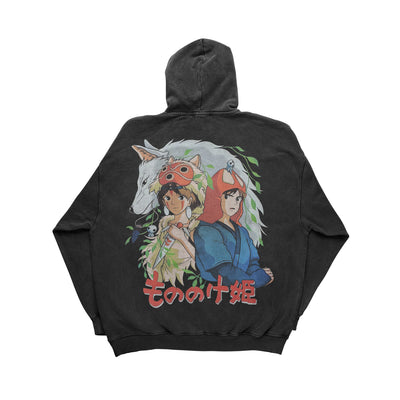
 Princess Mononoke San & Ashitaka Vintage Anime Hoodie Double Sided$24.99
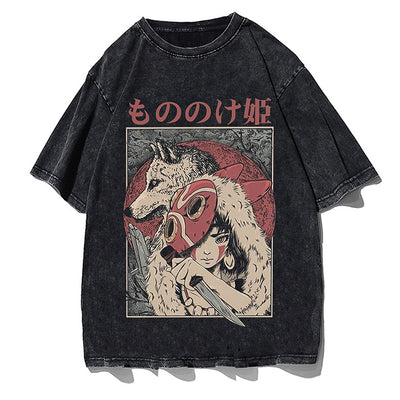
 Studio Ghibli Mononoke Hime Vintage Oversized Graphic T-Shirt$20.99
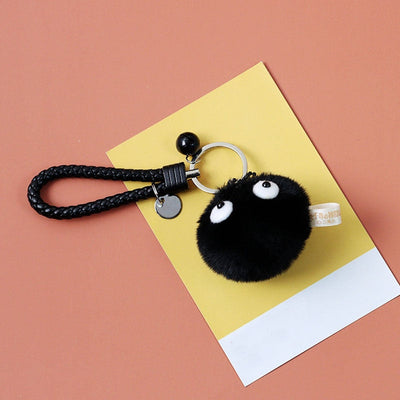
 Studio Ghibli Spirited Away Susuwatari Soot Sprite Plush Keychains$11.99
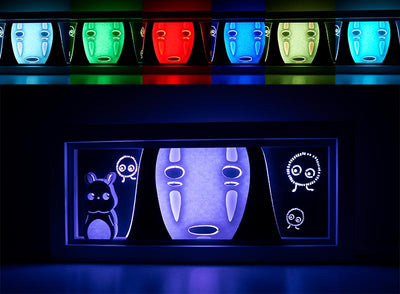
 Studio Ghibli Spirited Away Kaonashi No Face RGB Led Light Box$19.99
 Studio Ghibli Howl's Moving Castle Oversized Graphic T-Shirt$20.99
 Studio Ghibli Embroidered Jet Tag Keychain - Calcifer (Howl's Moving Castle)$9.99
Sources: Studio Ghibli, Castle in the Sky (official), Ghibli Museum, Mitaka (official).