
Fio Piccolo is the only Studio Ghibli heroine whose great talent is engineering, and she may be the most quietly modern character Hayao Miyazaki ever drew. She walks into Porco Rosso in Milan, a seventeen-year-old in a workshop full of grease, and takes over the story by doing the one thing nobody expects: the job.
Porco Rosso opened in Japan in July 1992. It is a film about an Italian flying ace cursed to look like a pig, about bounty hunting over the Adriatic and about the end of an age of seaplanes. Fio is the part of it that looks forward instead of back. Here is why she still hits more than thirty years later, without giving away how the film ends.
A workshop in Milan run by the women of one family

After a crash, Porco takes his broken red seaplane to Milan, to the old aircraft builder Piccolo. The men of the family have gone away to find work, so the women will build it.
Porco is not impressed, and the film enjoys his discomfort. Piccolo's workshop fills with his relatives, grandmothers, aunts and cousins, who arrive in their aprons and set to work on the hull and wings. The early 1930s are hard times in the film, and these women take the job because the family needs the money.
Miyazaki draws the workshop with real love: the plans pinned to the walls, the wooden frames, the long lunch table where everyone stops to say grace before they eat. It is one of the warmest stretches in any Ghibli film, and it sets up Fio as the one who knows exactly what all those hands should be doing.
The granddaughter who wants to redesign his plane

Fio is Piccolo's granddaughter, just back from America. When Porco learns that the new design will be hers, he wants to take his plane and leave.
The scene is a small battle of wills. Porco is a famous ace who flew in the war of 1914 to 1918; Fio is seventeen, and he says so. She does not argue about her age. She argues about the plane. She has looked at what is left of his old aircraft, she knows what it needs, and she is not going to apologise for being good at something.
Akemi Okamura voices Fio in Japanese with a quick, bright confidence that never tips into arrogance. Fio is direct because she cares about the work, not because she wants to win. Before the conversation is over Porco has agreed to trust her, and he looks a little surprised at himself for doing it.
A girl who stays up all night with the blueprints

Fio earns the job the honest way. While the others sleep, she works through the night on the new design, determined to prove she is the right person for it.
This is where the film makes its case for her. Fio is not a prodigy whose talent arrives by magic; she is a young engineer who works harder than anyone else in the room. Miyazaki has always loved people who are good with their hands, and Fio is the clearest example in all his films of someone defined by craft.
The rebuild that follows is a joy to watch. The hull is shaped, the wings are fitted, and the women of the family sing and eat and argue around a seaplane that grows more beautiful by the day. When the red plane finally rolls out, Fio stands beside it like an architect beside a finished building.
Seventeen and already a pilot's partner

When the plane is finished, Porco has to leave Milan in a hurry. Fio insists on coming with him, and the film puts her in the second seat as the red seaplane lifts off.
It is a lovely sequence. Fio has built planes but never flown in one at real speed, and her face during takeoff, part terror and part delight, says more than any line of dialogue. Porco keeps telling himself she is just a passenger. The film quietly shows that she is the one who understands the machine best.
Their partnership is the emotional centre of the film. Porco is a man who has given up on people and lives alone on a hidden beach. Fio talks to him as if he is still worth talking to, and you can watch the grumpy pig thaw, one scene at a time, without the film ever saying so out loud.
Facing down a gang of sky pirates

Back on the Adriatic, a band of seaplane pirates is waiting for Porco. Fio steps in front of them and talks to them about the honour of pilots until they are too ashamed to argue.
It is our favourite scene in the film, and it is pure Miyazaki. The pirates are loud, clumsy and not truly evil, and Fio treats them like boys who have forgotten their manners. She reminds them that seaplane pilots are supposed to be brave and fair, and one by one they shuffle their feet and agree with her.
The scene also shows why Fio matters to the whole film. Porco Rosso is full of men who live by an old code of honour that is slowly disappearing. Fio is a young woman who still believes in that code more than they do, and she is the one who reminds them what it was for.
A heroine who looks up at the sky

Miyazaki gives Fio the image she is best remembered by: standing on a wing over the blue sea, binoculars raised, scanning the sky for the next plane.
Fio belongs to a line of Ghibli heroines who are capable before they are anything else: Nausicaa with her glider in 1984, Sheeta with her crystal in 1986, Kiki with her broom in 1989. What sets Fio apart is that her gift is not magic or royalty. It is a trade, learned at a drawing board, and the film treats it with as much respect as any flying.
For many young viewers she was a first glimpse of a girl who builds machines in a story about planes, and that still feels fresh. The film never asks her to give up her talent or prove she belongs. It simply puts her where the work is and lets her be excellent.
Why Fio still matters

Porco Rosso was written and directed by Hayao Miyazaki for Studio Ghibli and scored by Joe Hisaishi. It grew from his own illustrated story about flying boats and began life as a short film for in-flight screens.
The project kept growing. Fio is a big part of why it works as a full feature. Without her, Porco Rosso would be a beautiful, melancholy film about a lonely man and a vanished era. With her, it becomes a film about passing that era on to someone young enough to carry it.
If you know Ghibli mostly through Totoro and Spirited Away, Porco Rosso is the next film to watch, and Fio is the reason it stays with you. She is proof that a story about the past can still have its eyes fixed firmly on the future.
Where to watch
Streaming catalogues for Studio Ghibli differ between the USA, the UK, Canada and Australia, and they change from month to month, so check the services you use.
Shop the Studio Ghibli collection
Liked Studio Ghibli? This is where it leaves the screen: every Studio Ghibli design we carry, in one place.
 Princess Mononoke San & Ashitaka Vintage Anime Hoodie Double Sided$24.99
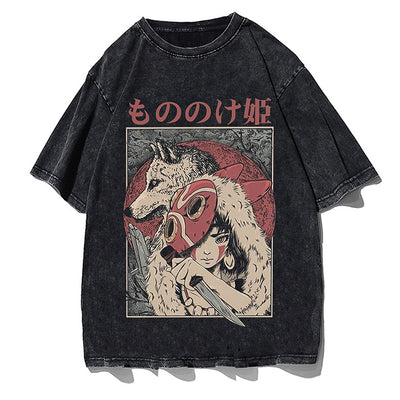
 Studio Ghibli Mononoke Hime Vintage Oversized Graphic T-Shirt$20.99
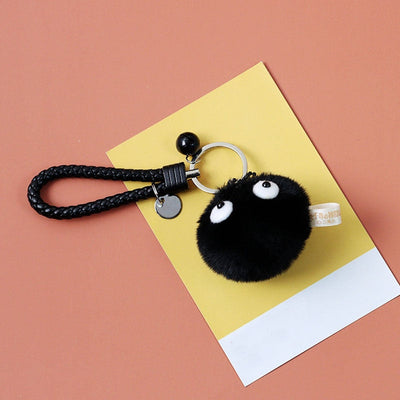
 Studio Ghibli Spirited Away Susuwatari Soot Sprite Plush Keychains$11.99
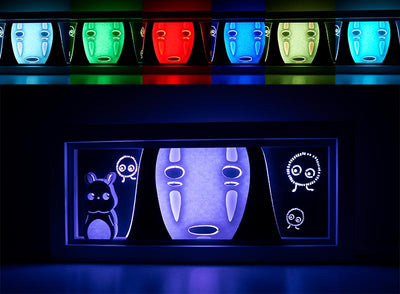
 Studio Ghibli Spirited Away Kaonashi No Face RGB Led Light Box$19.99
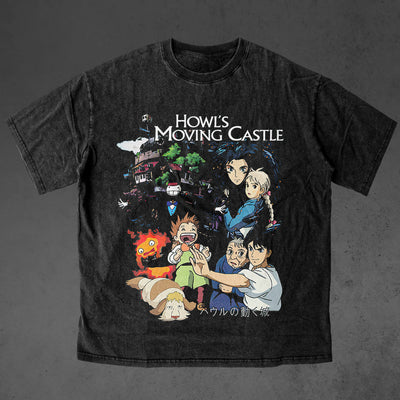
 Studio Ghibli Howl's Moving Castle Oversized Graphic T-Shirt$20.99
 Studio Ghibli Embroidered Jet Tag Keychain - Calcifer (Howl's Moving Castle)$9.99
Sources: Studio Ghibli, Porco Rosso (official), Ghibli Museum, Mitaka (official).