
My Neighbor Totoro has no villain, no battle and no ticking clock, and it is still the film that put a face on Studio Ghibli. The round grey spirit who waits at a bus stop in the rain is now the studio's logo, the plush toy in a million bedrooms and the first thing many children ever learn about Japanese animation.
We think it is the most quietly radical film Hayao Miyazaki ever made. It trusts children to carry a story about fear and waiting without a single explanation, and it trusts adults to remember what that felt like. Here is why a gentle film from 1988 still holds up better than almost anything made since.
An old house, a new start

Satsuki and her four-year-old sister Mei move with their father to an old house in the countryside, so they can be close to the hospital where their mother is recovering.
The opening twenty minutes are almost all exploration. The girls run through empty rooms, find a staircase nobody seems to use and chase the soot sprites, little black puffs of dust that, their elderly neighbor promises, drift away on their own from a happy house. Miyazaki would bring the same creatures back thirteen years later, hauling coal in Spirited Away.
Nothing is at stake yet, and that is the point. The film earns its later moments by letting us live in the house first: the creaking veranda, the rusted water pump, the bath where the whole family laughs out loud to chase away the night.
Mei finds a giant, and nobody explains him

Playing alone in the garden, Mei follows two small spirits into a tunnel of bushes and lands on the belly of a huge, sleepy creature. She asks his name, hears something like a growl, and decides he is Totoro.
The name comes from her picture book: Mei is trying to say troll. That one detail tells you how the film works. Totoro is never defined by a legend, a rule or a backstory. He is whatever a four-year-old sees, and the film refuses to correct her.
When Mei tells her father, he does not laugh at her. Tatsuo, a university lecturer, takes her to the giant camphor tree and bows to it. It is one of the warmest scenes of parenting in any animated film, and it decides the tone of everything after it.
A film about waiting for someone to come home

Under the summer light, My Neighbor Totoro is a story about a sick parent, told from the height of a child who is trying very hard to be brave.
Miyazaki's own mother spent years bedridden with spinal tuberculosis when he was a boy, and the film never treats that kind of absence as a plot device. The girls visit the hospital, their mother brushes Satsuki's hair, and the conversation is ordinary. The fear lives in what nobody says.
Satsuki carries most of it. She cooks the lunch boxes, walks Mei to school and acts like the adult of the house until the moment she cannot. We think that is why the film lands so hard on grown-ups who first saw it as children: on a second viewing you realise the story was about her all along.
The umbrella Kanta could not say sorry with

Kanta, the neighbor's boy, teases the sisters and calls their house haunted. Then a storm catches Satsuki and Mei outside, and he shoves his own umbrella at them and runs off into the rain.
He says nothing, gets soaked, and gets scolded at home for it. It is a tiny subplot, maybe five minutes across the whole film, and it is a perfect picture of how shy children apologise.
That umbrella sets up the film's most famous image. A few days later, waiting at the bus stop for their father in the rain, Satsuki sees a giant shape standing beside her with only a leaf on its head, and she offers Totoro her father's umbrella. Miyazaki builds his poster scene on the same small act of kindness, passed on from a boy who could not find the words.
The night the seeds grow

Totoro repays the umbrella with a small bundle of nuts and seeds tied up in a leaf. The girls plant them in the garden and check the bare earth every morning, waiting for something to happen.
Then, one night, they wake to find Totoro and the two small spirits dancing around the garden. The sisters join in, the shoots break through the soil and grow into a tree that rises above the house, and Totoro carries everyone into the sky on a spinning top.
By morning there are only a few green shoots. The film never tells us whether it was a dream, and the girls shout that it was a dream and it was not, both at once. That is the closest My Neighbor Totoro comes to a thesis: wonder is real for as long as you are willing to wait for it.
Kazuo Oga's countryside is the real star

Kazuo Oga, the film's art director, painted the backgrounds by hand, and he painted rice fields, shrines and summer clouds so precisely that you can almost smell the wet grass after the storm.
The landscape is modeled on the Sayama Hills around Tokorozawa, where Miyazaki lives, and it shows a Japan of the 1950s that was already disappearing when the film came out. There are no cars on the road for long stretches, only bicycles, a three-wheeled truck and a bus that comes when it comes.
Joe Hisaishi's score does the rest. The marching opening song, sung by Azumi Inoue, is one Japanese children still know by heart, and the quieter piano themes give the countryside its sense of summer slowing down.
How a modest release became a studio's face

My Neighbor Totoro opened in Japan on April 16, 1988, on a double bill with Isao Takahata's Grave of the Fireflies. It was not a big hit in cinemas. The plush toys that followed a couple of years later changed Studio Ghibli's fortunes, and Totoro became the studio's logo.
English speakers met it twice: first in a 1989 dub that Fox released on video in 1993, then in Disney's 2005 version with Dakota and Elle Fanning as Satsuki and Mei. Over in Mitaka, the Ghibli Museum, open since 2001, still screens Mei and the Kittenbus, a short sequel you can only see there.
In 2022 Satsuki and Mei's house became part of Ghibli Park in Aichi. Few films get to become a place you can walk into. We think this one earned it by doing something almost nobody else has managed since: making a family film that is calm, kind and completely gripping at the same time.
Where to watch
Streaming catalogues for Studio Ghibli differ between the USA, the UK, Canada and Australia, and they change from month to month, so check the services you use.
Shop the Studio Ghibli collection
Liked Studio Ghibli? This is where it leaves the screen: every Studio Ghibli design we carry, in one place.
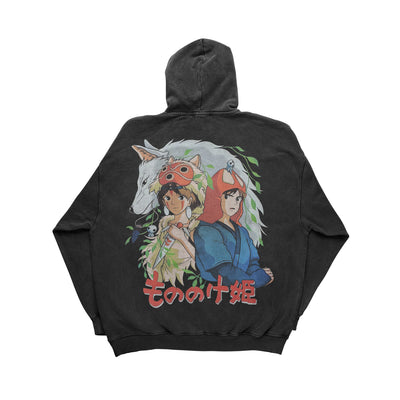
 Princess Mononoke San & Ashitaka Vintage Anime Hoodie Double Sided$24.99
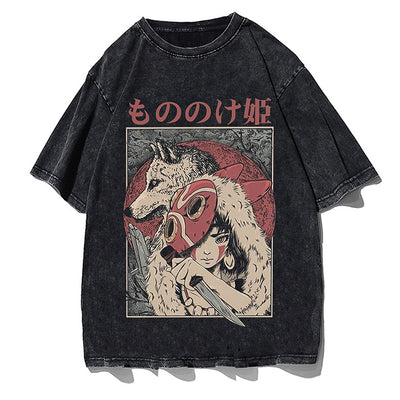
 Studio Ghibli Mononoke Hime Vintage Oversized Graphic T-Shirt$20.99
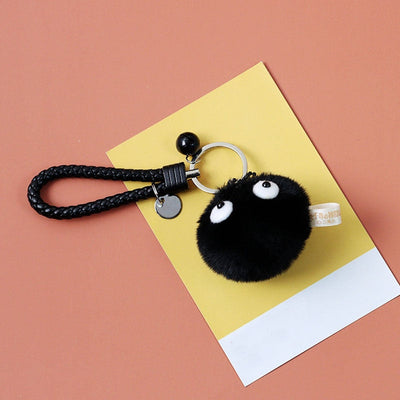
 Studio Ghibli Spirited Away Susuwatari Soot Sprite Plush Keychains$11.99
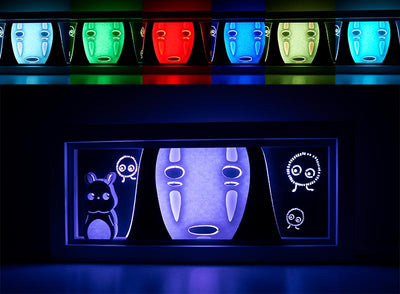
 Studio Ghibli Spirited Away Kaonashi No Face RGB Led Light Box$19.99
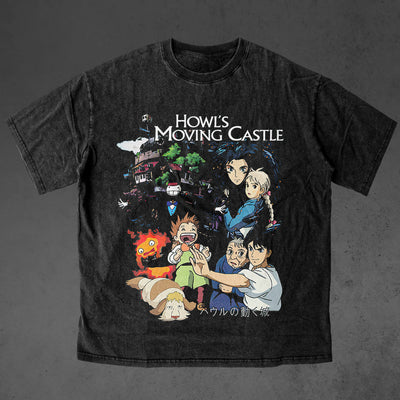
 Studio Ghibli Howl's Moving Castle Oversized Graphic T-Shirt$20.99
 Studio Ghibli Embroidered Jet Tag Keychain - Calcifer (Howl's Moving Castle)$9.99
Sources: Studio Ghibli, My Neighbor Totoro (official), Ghibli Museum, Mitaka (official), Ghibli Park (official).