
Howl's Moving Castle is the rare Studio Ghibli film that starts by taking its heroine's youth away, and we think that is exactly why it still hits harder every time you come back to it. Hayao Miyazaki released it in Japan in November 2004, adapted from Diana Wynne Jones's 1986 novel, and on paper it is a fairy tale about a wizard, a witch and a castle on chicken legs.
On screen it is something stranger and kinder: the story of a young woman who only starts living once she looks ninety. It has a fire demon with opinions, a scarecrow who never speaks, a war nobody explains and one of the most generous lead performances in animation. Here is why it still works twenty years on.
A hat maker who has stopped expecting anything

Sophie is eighteen and works in the hat store her late father left behind, sewing ribbons in a back room while the town outside celebrates soldiers marching off to war.
The film spends real time on how small her life has become. She wears plain dresses, keeps her hair tied back and tells herself she is the plain one, while her sister works in a busy bakery full of admirers. Miyazaki does not mock her for it. He shows a quiet, capable girl who has decided, too early, that nothing much is going to happen to her.
Then two soldiers corner her in an alley, and a blond stranger in a pink and blue jacket steps in, takes her arm and walks her up into the air above the rooftops. It is a gorgeous scene, but what makes it land is her face: she is terrified, delighted and completely unprepared for anyone to notice her at all.
The Witch of the Waste and a curse in one night

That evening a huge woman in furs sweeps into the store after closing. She is the Witch of the Waste, and with one touch she turns Sophie into an old woman.
The curse comes with a cruel twist: Sophie cannot tell anyone what happened to her. Akihiro Miwa voices the Witch in Japanese and Lauren Bacall in the 2005 English dub, and both play her as grand, vain and smiling, which is far more unsettling than a cackle. She is the kind of villain who seems to enjoy the visit.
What Sophie does next is the heart of the film. She does not scream or hide. She looks in the mirror, accepts the stiff back and the wrinkled hands, packs some bread and cheese and walks out of town before her family can see her. For the first time, she leaves home, and the curse is what gets her out of the door.
An old woman on the road to the Waste

Sophie hitches a ride on a hay cart up into the hills, a tiny bent figure on top of the bales with green valleys and white mountains spread out behind her.
This stretch is where Miyazaki lets the film breathe. There is almost no plot, only Sophie grumbling about her knees, cutting herself a walking stick and enjoying the view more than she ever enjoyed her own street. Chieko Baisho voices Sophie in Japanese at both ages, and the choice pays off here, because the old woman sounds like the young one finally speaking her mind.
On the way she frees a scarecrow with a turnip for a head from a bush, and he hops after her as a silent, loyal companion. Turnip Head is one of Ghibli's great small inventions, comic and slightly eerie, and he leads Sophie to the thing she came to find without saying a word.
Calcifer, the fire with a contract

The castle that lumbers out of the fog is a heap of turrets, chimneys and pipes on bird legs, and inside, in the hearth, lives Calcifer, a fire demon who keeps the whole thing moving.
Calcifer is bound to Howl by a contract neither of them will explain, and he offers Sophie a deal on the first night: help him break it, and he will break her curse. Tatsuya Gashuin voices him in Japanese and Billy Crystal in English, and in both he is grumpy, vain and secretly soft, a fire who sulks when nobody feeds him logs.
He is also the film's most practical character. Calcifer heats the water, powers the castle and complains about all of it. The animators give him a whole range of moods with a few flickers of flame, and every scene in the hearth feels like a scene with a roommate rather than a magic effect.
Bacon, eggs and a wizard who cooks

Sophie announces that she is the castle's new cleaning lady, and the next morning Howl comes home, takes the pan from her and cooks breakfast over Calcifer himself.
It is one of the most loved food scenes in any Ghibli film: thick bacon, cracked eggs, a fire demon groaning under the pan and Markl, Howl's young apprentice, digging in the moment the plate lands. Takuya Kimura voices Howl in Japanese and Christian Bale in English, and in this scene the famous wizard is mostly a young man who likes his breakfast.
That is the film's quiet trick. Howl is rumoured across the kingdom to eat the hearts of pretty girls, and in his own kitchen he is vain, kind, lazy and funny. Sophie sees the rumour and the man side by side and decides for herself, which is the opposite of the girl in the hat store who believed whatever she was told about herself.
A door that opens onto four places

The castle's front door has a dial with coloured marks, and each turn opens it onto a different place: a seaside town, a royal capital, the hills of the Waste and somewhere dark.
It is a simple idea that makes the castle feel enormous. Step out one way and you are in Porthaven, a harbour town where Markl runs errands and Sophie buys fish at the market; step out another and you are in a grand city where Howl goes by another name entirely. Each place is painted with its own light and weather, and the film loves wandering through all of them.
The door also tells you who Howl is. He keeps several names, several homes and several ways out, and he never stays anywhere long enough to be pinned down. Sophie, who has lived her whole life in one street, becomes the person who cleans every room and opens every door, and the castle slowly starts to look like a home.
A war in the background that never stops

From the first scene there are soldiers in the streets, warships in the sky and posters on the walls, and the war only grows louder as the film goes on.
Miyazaki never explains who is fighting whom or why, and that is the point. The parades in the opening are bright and cheerful, full of flags and cheering crowds, and the film lets you notice how quickly that cheer curdles. The war is not a plot to follow; it is weather, always on the horizon, pulling the people you care about toward it.
It gives the fairy tale real weight. Howl's refusal to be drafted, the empty skies after an air raid and the way ordinary towns are drawn as worth protecting all come from a director who has always been clear about what he thinks war costs. We think it is the most quietly angry film he has made, and it still feels current.
Why Howl's Moving Castle still holds up

Hayao Miyazaki wrote and directed the film for Studio Ghibli in 2004 after Mamoru Hosoda, first set to direct it, left the project. Joe Hisaishi wrote the score, built around the waltz Merry-Go-Round of Life.
That waltz is the film's secret weapon. It plays over the walk in the sky, over the hills and over the castle's first steps, and it changes mood each time, from giddy to sad to triumphant. Many viewers who barely remember the plot can hum it, and it has become one of the most performed pieces in Ghibli's whole catalogue.
The film was nominated for the Academy Award for Best Animated Feature in 2006, and it has only grown since. Watch it for the castle, the fire and the bacon, and notice how Sophie's age shifts from scene to scene, younger when she is brave and older when she doubts herself. It is the clearest picture of confidence we know of in animation.
Where to watch
Streaming catalogues for Studio Ghibli differ between the USA, the UK, Canada and Australia, and they change from month to month, so check the services you use.
Shop the Studio Ghibli collection
Liked Studio Ghibli? This is where it leaves the screen: every Studio Ghibli design we carry, in one place.
 Princess Mononoke San & Ashitaka Vintage Anime Hoodie Double Sided$24.99
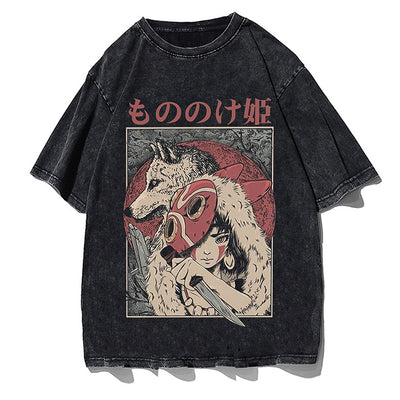
 Studio Ghibli Mononoke Hime Vintage Oversized Graphic T-Shirt$20.99
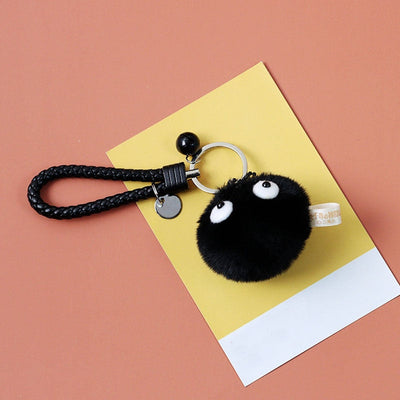
 Studio Ghibli Spirited Away Susuwatari Soot Sprite Plush Keychains$11.99
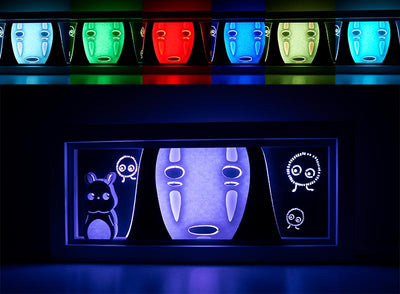
 Studio Ghibli Spirited Away Kaonashi No Face RGB Led Light Box$19.99
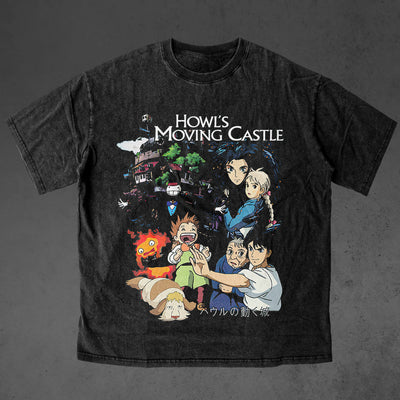
 Studio Ghibli Howl's Moving Castle Oversized Graphic T-Shirt$20.99
 Studio Ghibli Embroidered Jet Tag Keychain - Calcifer (Howl's Moving Castle)$9.99
Sources: Studio Ghibli, Howl's Moving Castle (official), Ghibli Museum, Mitaka (official).